
Correlation Between U.S. Policy & Islamic Republic Escalation and Economic Trends
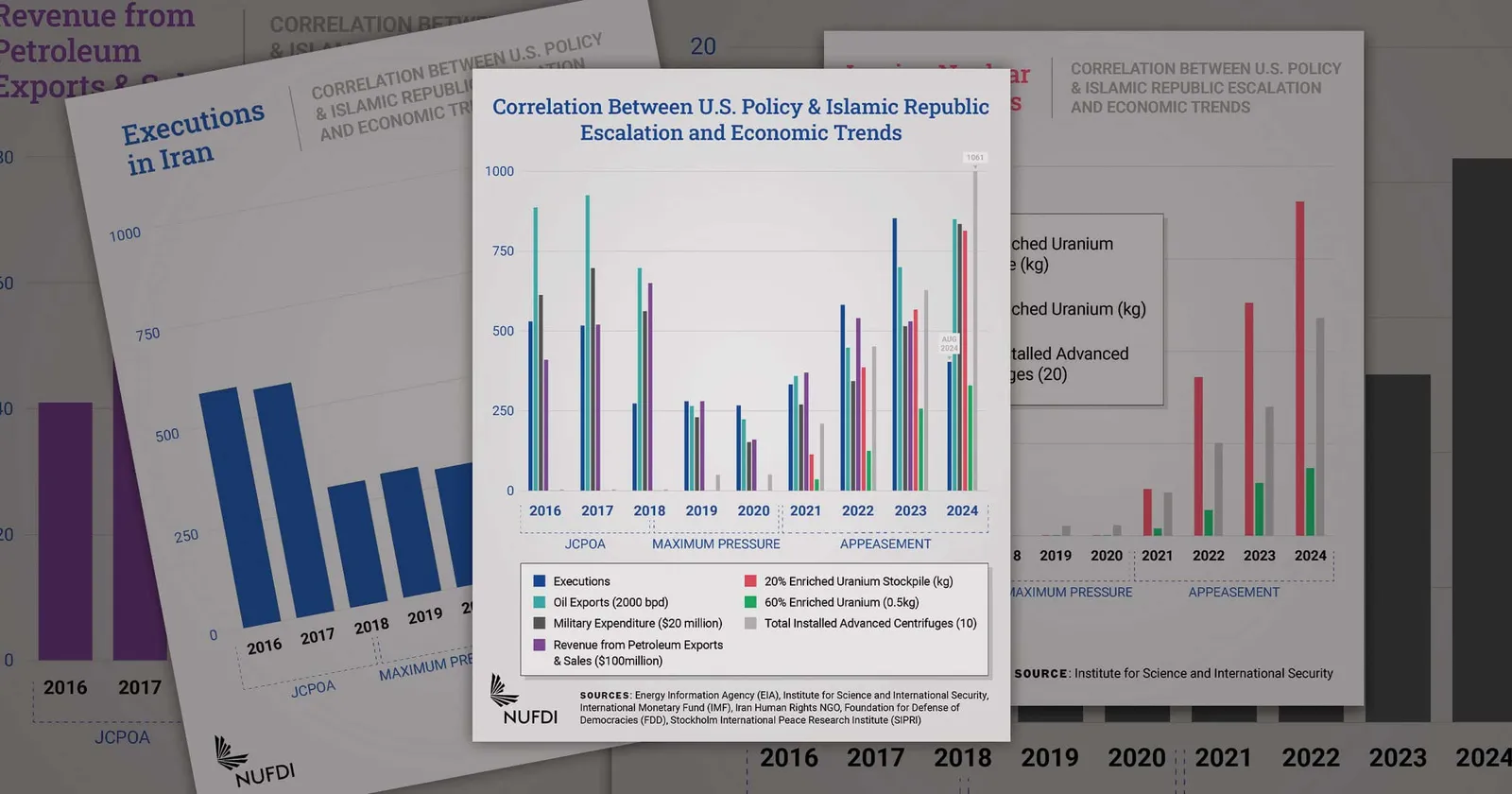
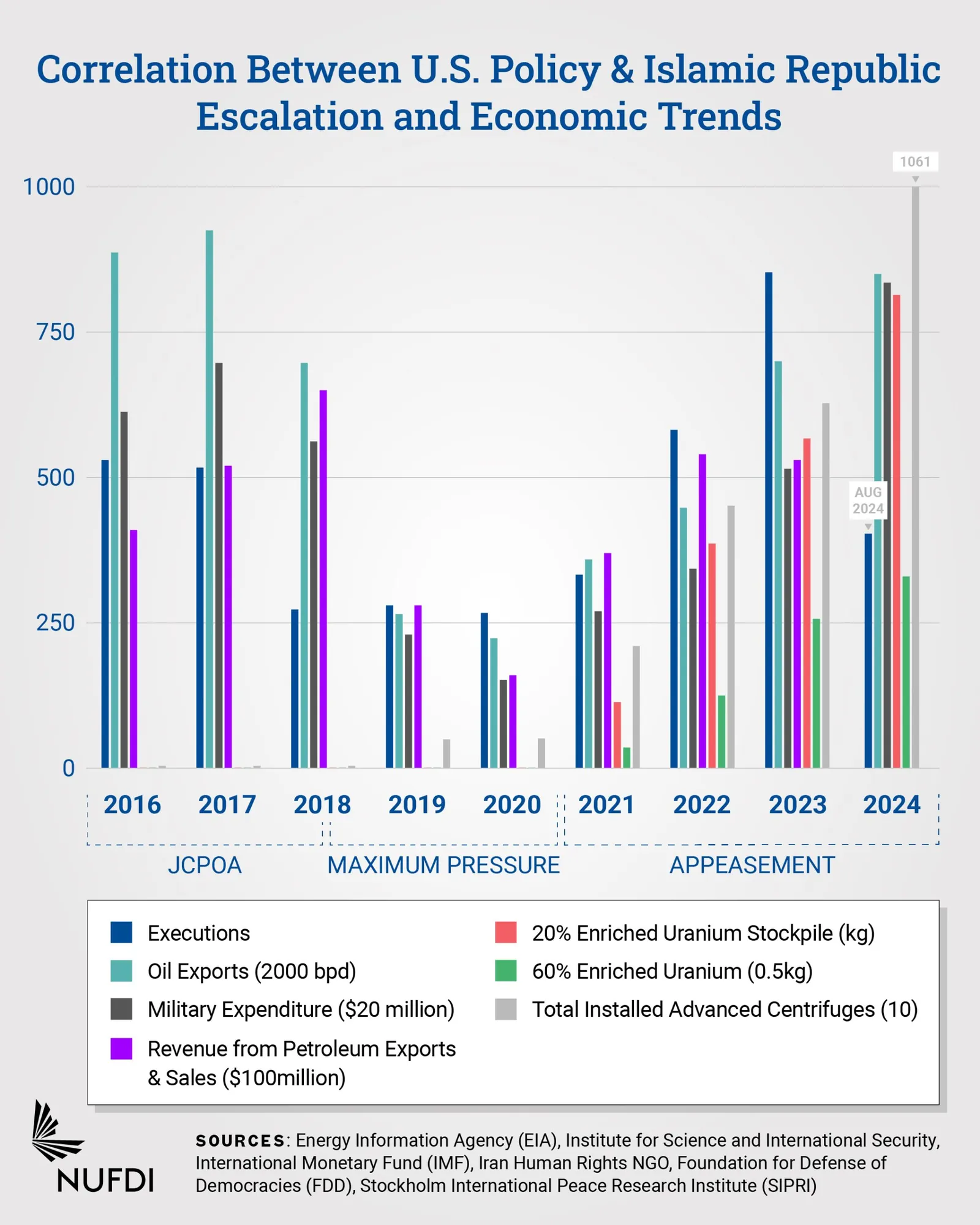
By Andrew Ghalili, NUFDI Senior Policy Analyst Recent data on the regime in Iran’s oil exports, military spending, nuclear development, and internal repression reveal troubling trends. As U.S. policy towards the Islamic Republic continues to shift, these numbers highlight how Tehran has capitalized on a softer stance from Washington, growing its military capabilities, nuclear program, and financial power, while simultaneously increasing domestic human rights abuses.
An in-depth analysis of the updated figures from 2016 to 2024 points to a concerning correlation: as U.S. pressure on the regime decreases, its aggressive actions rise. While correlation is not definitive causation, the consistent alignment between policy shifts and the Islamic Republic’s behavior is difficult to dismiss.
Oil Exports
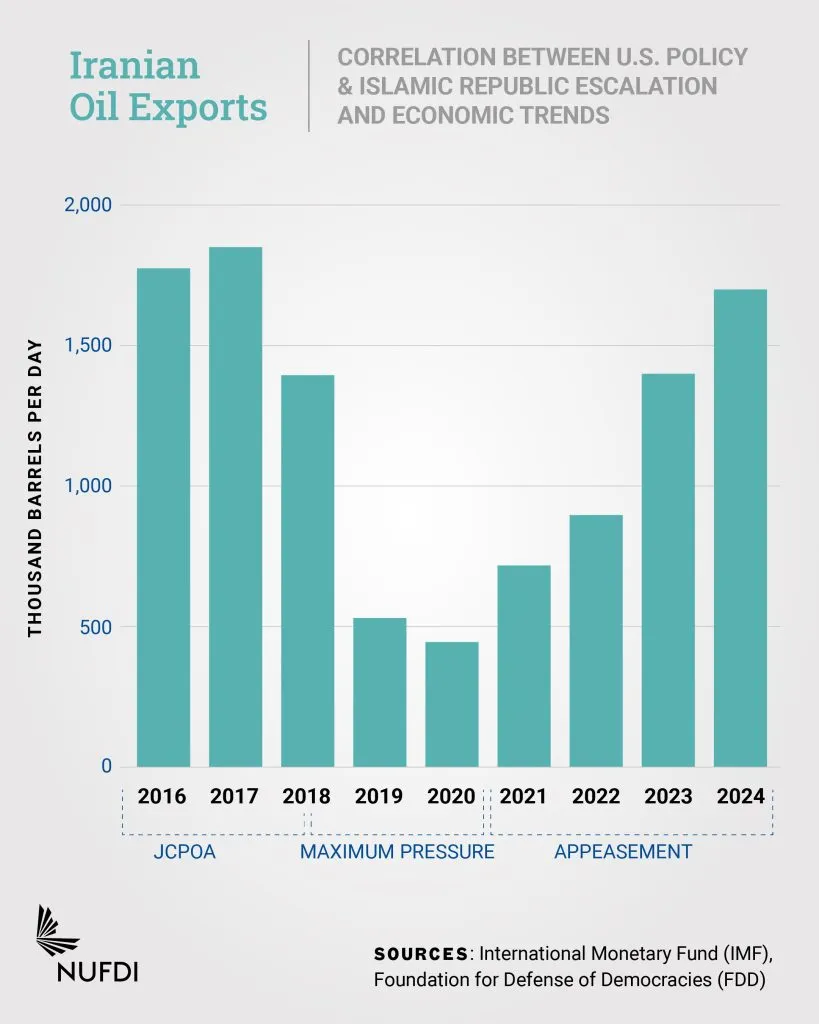
One of the clearest indicators of U.S. influence on the regime’s economy is its (https://fred.stlouisfed.org/series/IRNNXGOCMBD). From 2018 to 2020, when sanctions were rigorously enforced after the United States withdrew from the Joint Comprehensive Plan of Action (JCPOA), oil exports plummeted, falling from over 1.7 million barrels per day (bpd) in 2017 to just 444,670 bpd in 2020. This sharp drop in exports dramatically reduced the regime’s financial resources.
Since 2021, as the Biden-Harris administration shifted U.S. policy on Iran towards appeasement–or what some would call diplomacy–and efforts to revive the JCPOA, oil exports steadily climbed again. By 2024, the regime is exporting (https://www.fdd.org/analysis/2024/10/21/biden-administration-admits-irans-oil-exports-have-grown-exponentially-in-value-and-volume/#:~:text=Iran%20currently%20exports%20around%201.7,is%20currently%20above%205%20mbpd.) 1.4 million bpd, a significant recovery that has provided it with the economic flexibility to further its destabilizing activities across the Middle East.
Military Spending
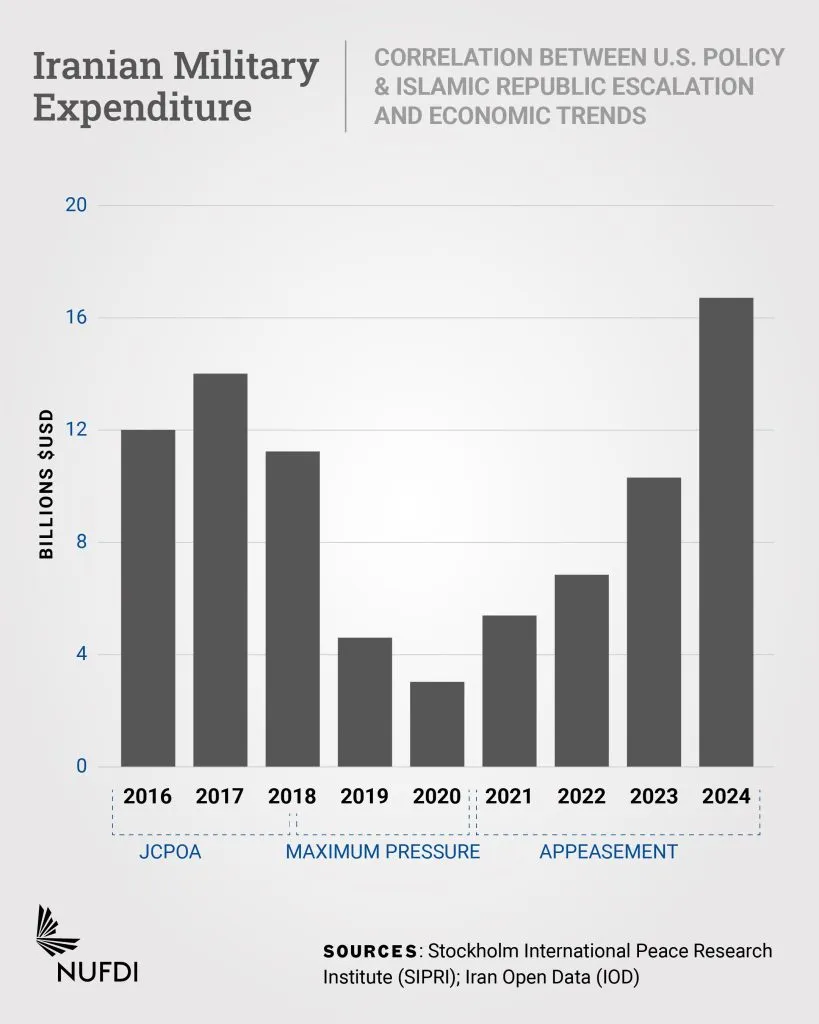
The Islamic Republic’s (https://www.sipri.org/databases/milex) reflects the same pattern of economic recovery. After hitting a low of just $3.03 billion in 2020, Tehran’s military budget has rebounded, reaching $16.7 billion in 2024. This resurgence aligns with the recovery in oil revenues, as the regime continues to prioritize military spending—including support for terrorist groups and regional militias—over the welfare of the Iranian people.
U.S. policy has repeatedly aimed to regulate how the regime allocates its resources by allowing limited financial transactions for humanitarian purposes. However, the fungibility of money makes this a flawed approach, as evidenced by the consistent increase in military spending whenever the regime’s revenue streams improve. Tehran has demonstrated that it will channel its resources toward securing its regional influence and expanding its military capabilities at every opportunity.
Executions
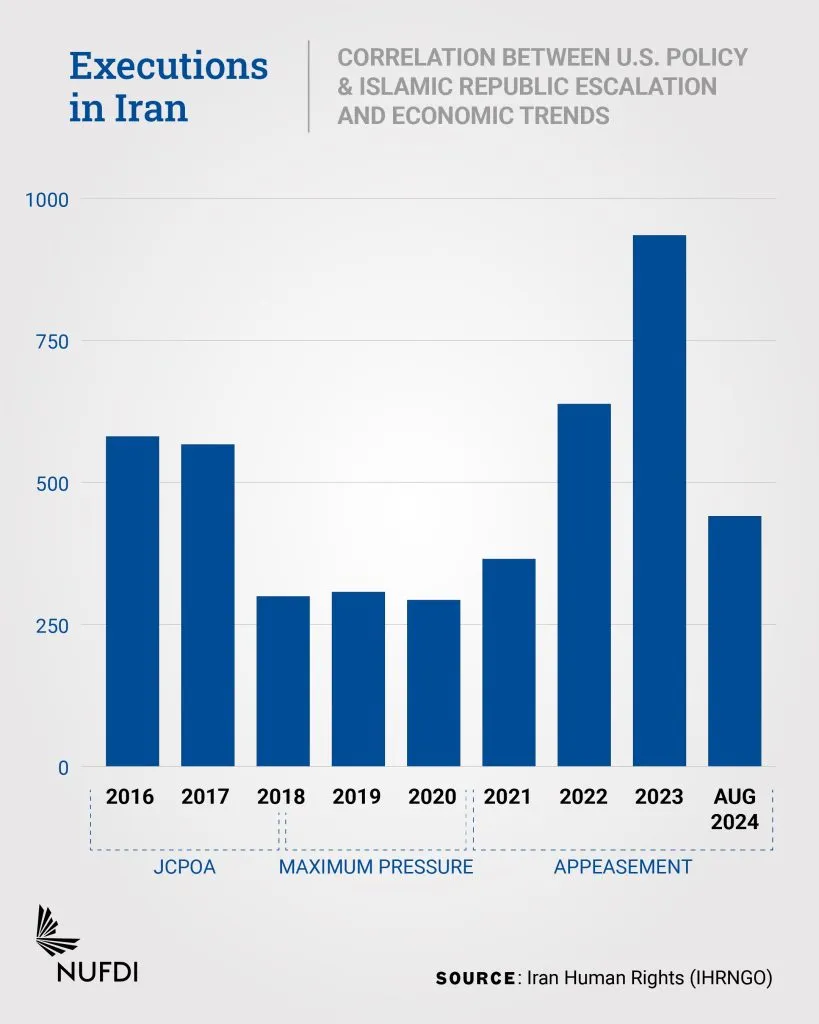
Internally, the Islamic Republic’s human rights abuses have also worsened as its economy and military have strengthened. The data on executions illustrates this grim reality. After a notable dip to 267 executions in 2020, the number of people executed in the regime soared to 853 in 2023. This increase is alarming and suggests that as the regime’s financial situation improves, it feels more emboldened to escalate its repression of domestic dissent.
While factors like the transition from the more moderate President Rouhani to the hardline President Raisi in 2021 certainly contribute to this trend, U.S. policy cannot be dismissed as a factor. When Washington adopts a weaker stance, particularly one focused on appeasement and the re-entry into nuclear negotiations, the regime in Iran appears less fearful of international scrutiny and emboldened to commit further human rights violations with little consequence.
Nuclear Advancements
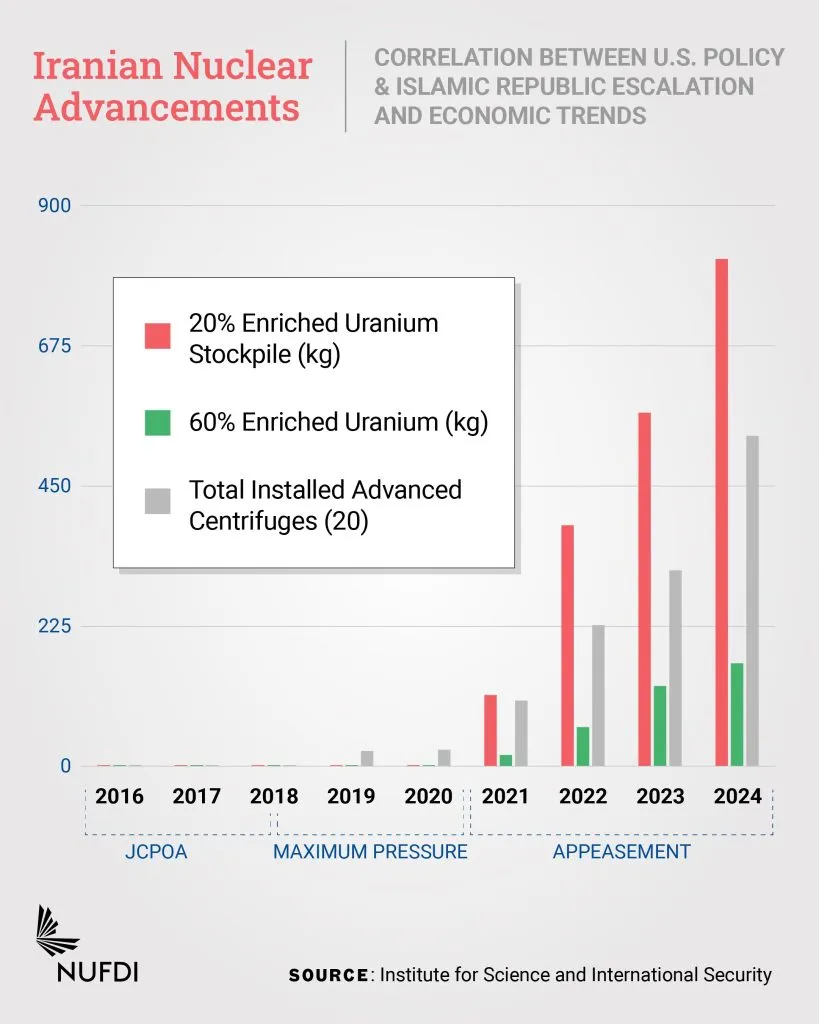
Perhaps the most concerning trend in this data set is the significant advancements in the Islamic Republic’s (https://isis-online.org/countries/category/iran). While the JCPOA initially succeeded in temporarily curtailing Iran’s nuclear ambitions, the regime’s nuclear development has accelerated to the point where it could acquire enough enriched uranium for a nuclear bomb within one week. This acceleration didn’t begin when the United States withdrew from the JCPOA, however, but rather when the Biden-Harris administration entered office with the stated mission of relieving pressure on Iran to re-enter the JCPOA.
In 2020, the Islamic Republic had no 20 or 60 percent enriched uranium. By 2024, it has amassed 813.9 kg of 20% enriched uranium and 164.7 kg of 60% enriched uranium. The number of installed advanced centrifuges has also skyrocketed from 512 in 2020 to over 10,600 by 2024, drastically reducing the regime’s nuclear breakout time and bringing it closer to a weapons-grade nuclear capability.
These figures show, at the very least, that the U.S. pursuit of endless diplomacy did nothing to slow the regime’s nuclear program. At worst, they suggest that appeasement in the name of a new nuclear deal actually accelerated the pace of the program’s progress, in turn killing any hopes of said deal. U.S. policymakers must accept that the nuclear deal is effectively defunct, and the Islamic Republic has shown no genuine interest in renegotiating a deal that would meaningfully constrain its nuclear ambitions, let alone one that also curtails its malign activity including terrorism, transnational repression, and hostage taking.
Revenue from Petroleum Exports
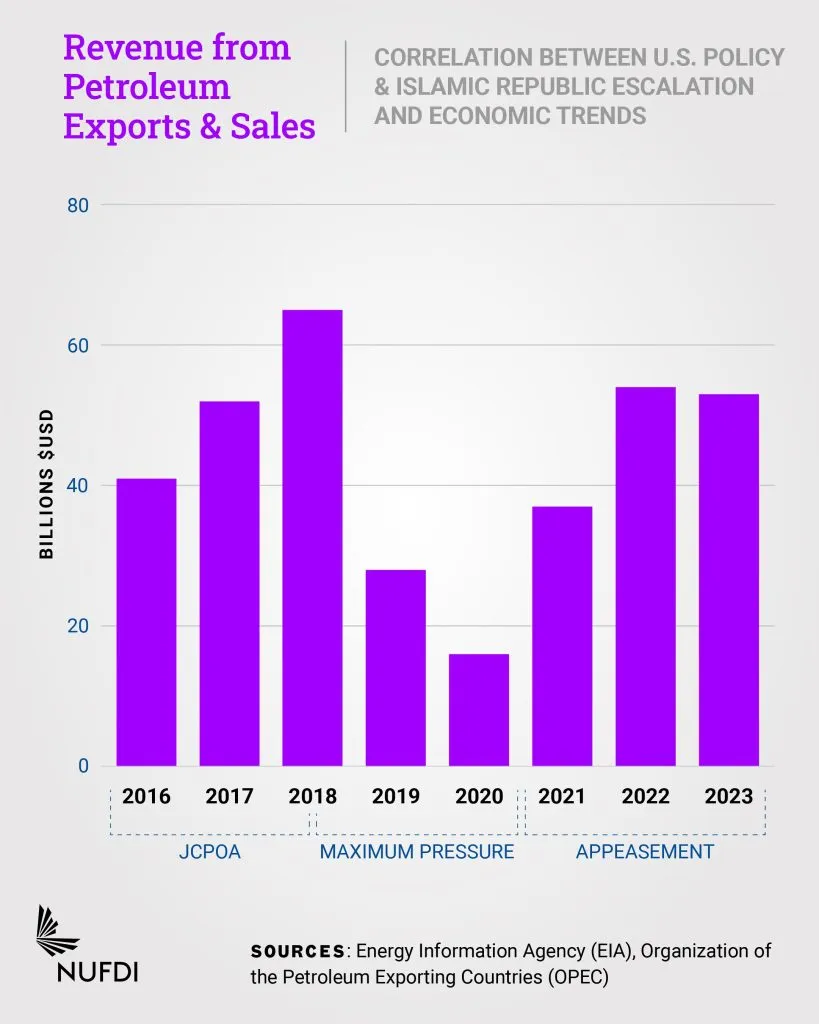
As recently outlined in the SHIP Act-mandated EIA (https://www.eia.gov/international/analysis/special-topics/SHIP_Act), between 2021 and 2023, the regime in Iran made $144 billion from oil sales. It raked in $53 billion in 2023, compared to just $16 billion in 2020 after less than two years of stricter sanctions. This rapid rise in revenue underscores how weaker sanctions enforcement has allowed the Islamic Republic to dramatically boost its economic power, fueling its malign activities.
The SHIP Act report confirms that under the Biden administration, the Islamic Republic’s oil exports tripled in both volume and value compared to the last two years of the previous administration. This sharp increase in petroleum sales—both in crude and products—illustrates the significant financial windfall enjoyed by the regime as a direct result of reduced U.S. enforcement of oil sanctions, despite the regime’s ongoing destabilizing actions.
Summary
The updated data illustrates a clear pattern: as U.S. pressure on the Islamic Republic decreases, the regime’s malign activities increase. When Washington takes a softer approach—whether through weaker sanctions enforcement or diplomatic negotiations—the regime exploits the opportunity to ramp up its military spending, advance its nuclear program, and intensify its repression of the Iranian people.
The regime’s economy, and thus its ability to finance its malign activities, is directly tied to its oil sales. Only by severely restricting this source of income can the international community hope to limit the Islamic Republic’s aggressive ambitions both at home and abroad.
Policymakers in the United States must acknowledge that appeasement has consistently empowered the Islamic Republic, while a firm and consistent pressure-based approach is more effective at curbing its aggressive behavior. Any future strategy must combine maximum pressure on the regime with maximum support for the Iranian people’s struggle for freedom and human rights.